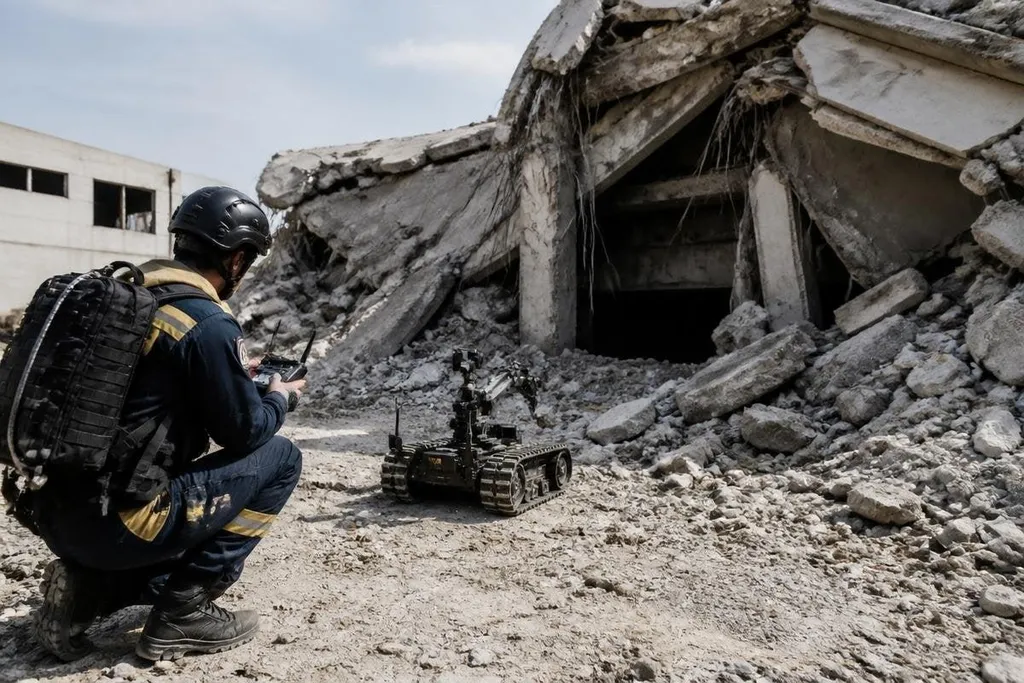
A disaster robot may enter a collapsed building before a person can safely do so. Its value will depend on what it can show, carry, and report when dust, water, heat, and broken communications interfere.
For emergency teams, the question is practical: can the robot reduce risk without adding another system to manage?
- Search first: map unsafe spaces and report signs of people or damage.
- Keep contact: carry cameras, radios, or other sensors into areas blocked to crews.
- Fail clearly: show when its data is weak, its battery is low, or its link has dropped.
The first jobs will stay narrow
Disaster sites change too quickly for a robot to handle every task on its own. A machine may map a damaged floor, inspect a pipe, carry a small load, or send video from a tunnel. Each job needs a different body, sensor set, and control method.
That points to fleets of smaller systems rather than one machine built for every emergency. A drone can view roofs and open ground. A tracked robot can cross loose debris. A legged robot may step over gaps, but it also brings more moving parts and harder control problems.
The useful measure is not how many tasks a robot can perform in a controlled demo. It is whether an emergency team can assign one task, read the result, and act on it without wasting time.
Seeing people is harder than seeing rubble
Cameras can lose detail in smoke, dust, darkness, or harsh sunlight. LiDAR, which measures distance with laser pulses, can build a map when a camera struggles, but it may still miss soft objects or areas blocked by debris.
Thermal cameras can show heat patterns, yet a warm mark does not prove that a person is there. A rescue team needs location, confidence, and a way to check the finding before sending people into danger.
The robot also needs to explain its limits. A map with missing sections, delayed video, or uncertain detection should appear as uncertain data, not as a clean picture that invites a false decision.
That uncertainty belongs in the report, too. Disaster robotics reports from Robot24.com can connect a robot’s task to its test conditions, date, human control, and recorded result. Those details matter before the next section asks how much work autonomy can take on beside people.
Autonomy will work beside human control
A robot may need to move through a site when a radio link is weak or the route has changed.
Full remote control can become slow when video is delayed. Full autonomy can make a poor choice when the map no longer matches the building.
A better working pattern gives the robot small decisions and keeps high-risk choices with a trained operator. The system might keep itself upright, avoid a drop, or return along a known route. A person could choose where to search, which path to inspect, and when to stop.
This arrangement also makes failures easier to manage. If the link breaks, the robot needs a clear response such as stopping, returning, or holding its position. The correct choice depends on the site, so emergency teams will need to set it before deployment rather than during a rescue.
Batteries and training decide the result
A machine that runs out of power beside a victim has created a recovery job. Teams need to know how long the robot can work with its cameras, lights, motors, and radio active. They also need a safe way to change batteries or recover the machine.
Training matters just as much. An operator who knows the robot's controls still needs practice reading maps, checking sensor gaps, and judging when the machine is stuck. Emergency crews may also need a simple handoff process so a new operator can take control without losing the search record.
I’d back robots built around a few repeatable rescue tasks before systems sold as general disaster helpers. Narrow work gives teams a clearer test and gives builders a shorter list of failures to fix.
A field checklist for rescue teams
Before adding a disaster robot to an emergency plan, check these points:
- Name the task: decide if the robot will map, inspect, carry equipment, or relay communications.
- Set the control mode: record which actions need an operator and which actions the robot may handle.
- Test the link: measure what happens when video or control data arrives late or stops.
- Check recovery: plan how staff will move, power, and retrieve a disabled robot.
- Record uncertainty: require maps, detections, and sensor readings to show gaps or low confidence.
- Train under pressure: run the same task with smoke, dust, darkness, tight spaces, or damaged routes where safe.
The next useful proof will come from repeated field exercises, not a single clean run. Disaster robots will earn a place in rescue plans when teams can state the task, trust the limits, and recover the machine after the search.